

Akshat Srivastava

Enterprise AI is entering its second, more demanding phase. The first phase proved that large language models can reason, summarize, generate, and automate. The next phase asks a harder question: can these systems operate with the precision, governance, and business awareness required in real enterprise workflows?
That gap is not solved by model size alone. It is solved by context: the policies, customer records, product rules, operational constraints, exceptions, regulatory guidance, and institutional memory that make an AI response trustworthy. Context Engineering is the emerging Data Engineering discipline for designing, managing, optimizing, and delivering that information to AI systems at the right moment.
Many AI initiatives follow the same arc: a compelling proof of concept, strong executive interest, and then friction when the solution meets production reality. The model can answer fluently, but it cannot reliably distinguish between an active policy and an archived one, a preferred customer and a restricted account, a stocked product and a discontinued SKU, or a general guideline and a facility-specific rule.
A banking assistant that cites an outdated loan product creates compliance exposure. A retail support copilot that ignores live inventory damages customer trust. A healthcare documentation assistant that misses local protocols introduces clinical risk. These failures are often described as hallucinations, but the deeper issue is architectural: the AI system is operating without the right enterprise context.
| Enterprise AI Problem | Traditional Data Warehouses |
|---|---|
| Hallucinations | The AI fills knowledge gaps with plausible but unsupported answers. |
| Missing business knowledge | Policies, customer history, product rules, and exceptions are not available at inference time. |
| Fragmented data | Knowledge is spread across warehouses, CRM, ERP, documents, APIs, and tickets. |
| Poor retrieval | RAG retrieves stale, irrelevant, incomplete, or unauthorized context. |
| Context overload | Too much information increases latency, cost, and confusion. |
Context Engineering is the discipline of designing, managing, optimizing, and delivering the right information to AI systems at the right time. It treats enterprise knowledge as a product: curated, governed, versioned, measured, and served through reliable infrastructure.
Prompt engineering asks, 'How should we phrase the instruction?' Context Engineering asks, 'What evidence, memory, permissions, and business rules must the model receive before it answers?' That distinction matters. Better prompts can improve tone and behavior; better context changes the factual foundation of the response.
| Discipline | Primary Focus | Time Horizon | Enterprise Role |
|---|---|---|---|
| Prompt Engineering | Instructions | Single interaction | Useful for phrasing and behavior control |
| Context Engineering | Knowledge delivery | Full AI system lifecycle | Essential for grounded enterprise outcomes |
| Era | Focus |
|---|---|
| Data Engineering | Data Pipelines |
| ML Engineering | Feature Pipelines |
| Prompt Engineering | Instruction Design |
| Context Engineering | Knowledge Delivery |
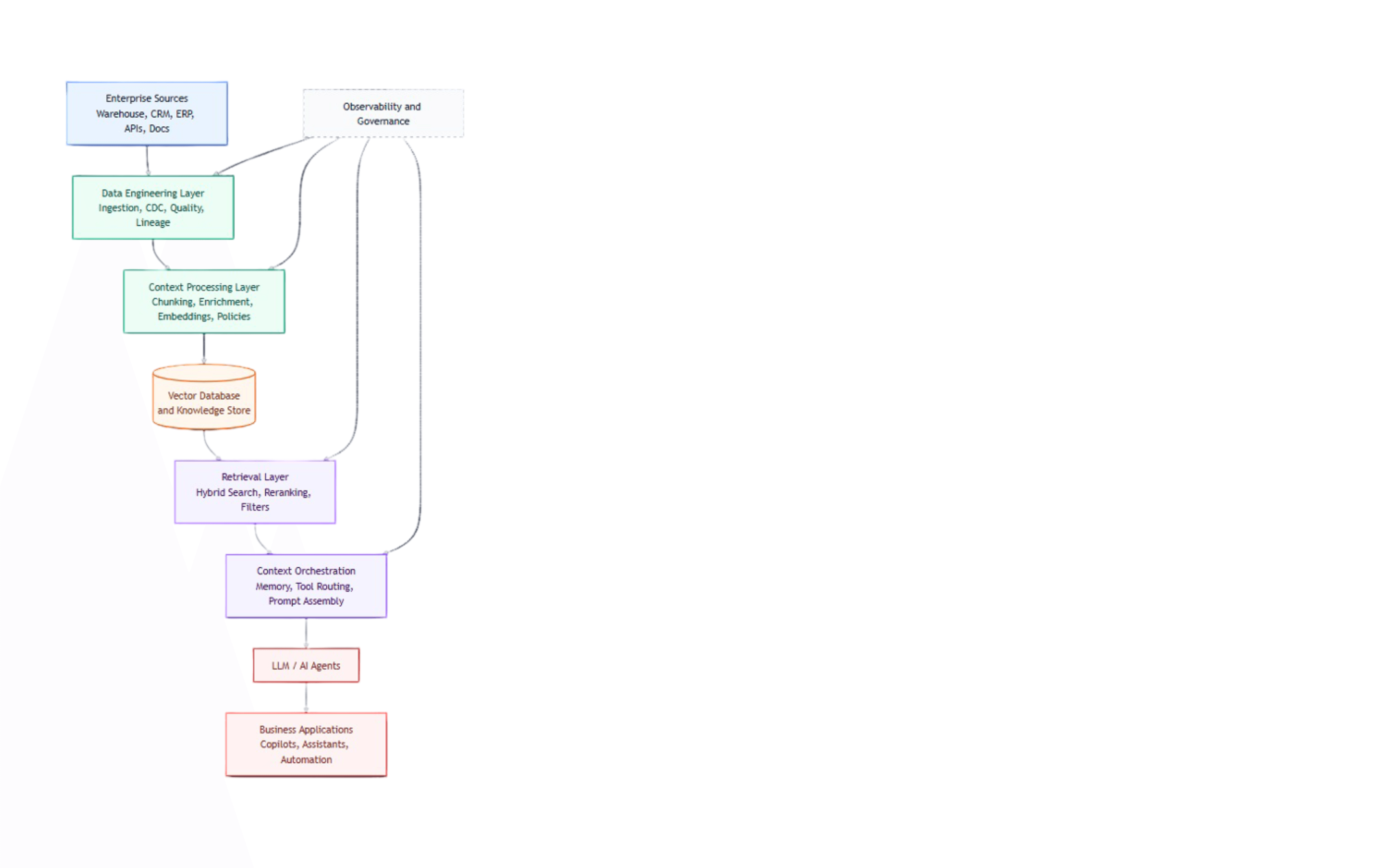
A production-grade context architecture extends the enterprise data platform into the AI runtime. It does not simply attach a vector database to a chatbot. It establishes a controlled path from source systems to AI applications, with quality, metadata, access control, retrieval logic, orchestration, and observability built into the flow.
| Layer | Engineering Responsibility |
|---|---|
| Context Collection | Ingest warehouses, knowledge bases, CRM, ERP, APIs, documents, and operational systems. |
| Context Processing | Chunk content, enrich metadata, generate embeddings, classify sensitivity, and score freshness. |
| Context Delivery | Use RAG, memory layers, agent frameworks, retrieval ranking, and knowledge injection. |
| Context Observability | Track precision, recall, groundedness, latency, cost, feedback, and hallucination signals. |
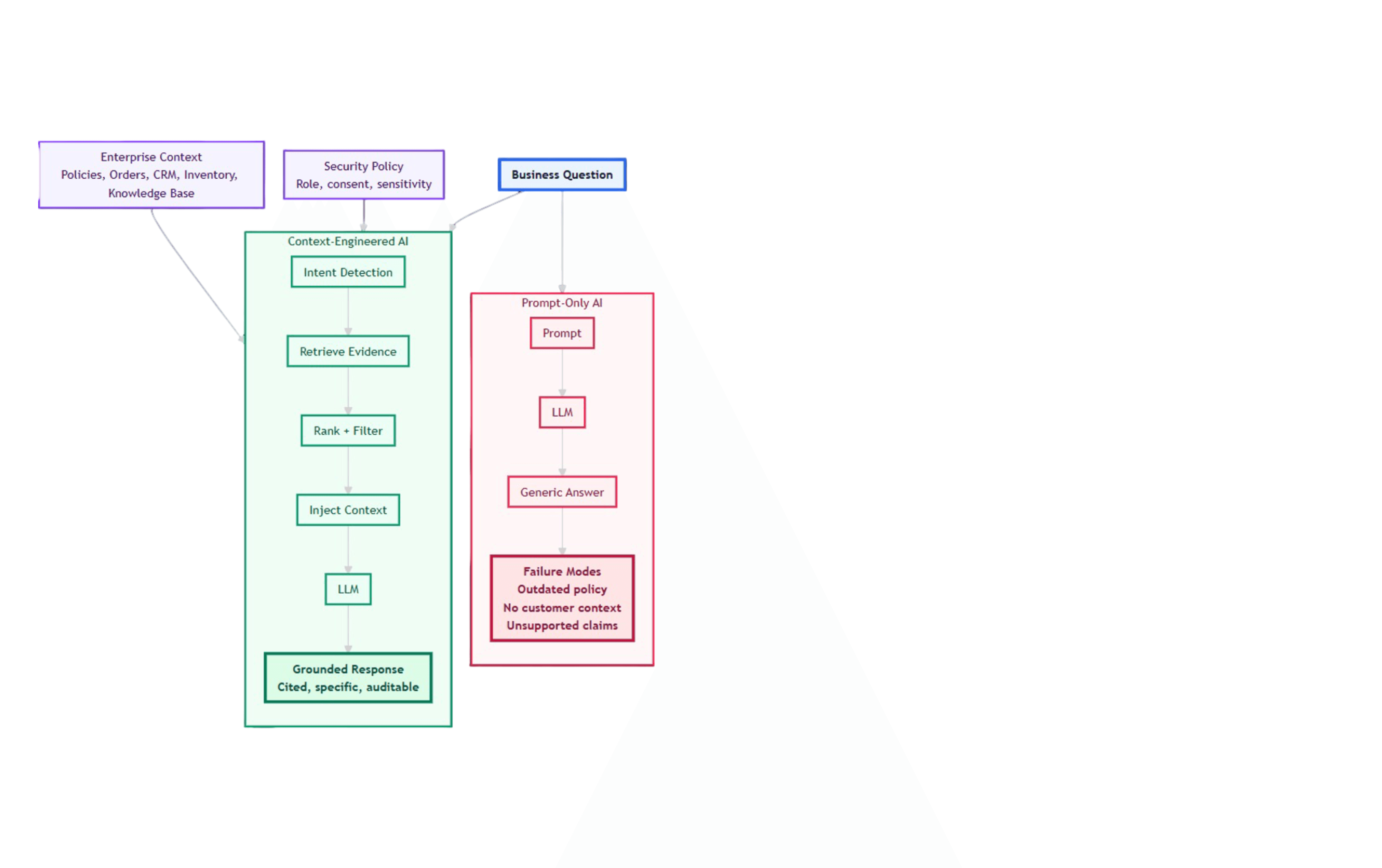
Consider a customer asking, 'What is our return policy for electronics purchased during the holiday sale?' A prompt-only AI system may respond with a generic retail policy that sounds reasonable but misses the actual sale window, product category exception, and customer order status. A context-engineered system retrieves the approved holiday policy, validates the SKU category, checks the customer's order, applies access rules, and generates a grounded answer with source-backed confidence.
The business difference is significant. The first response is conversational. The second is operationally useful. It can be audited, improved, and trusted in a customer-facing workflow.
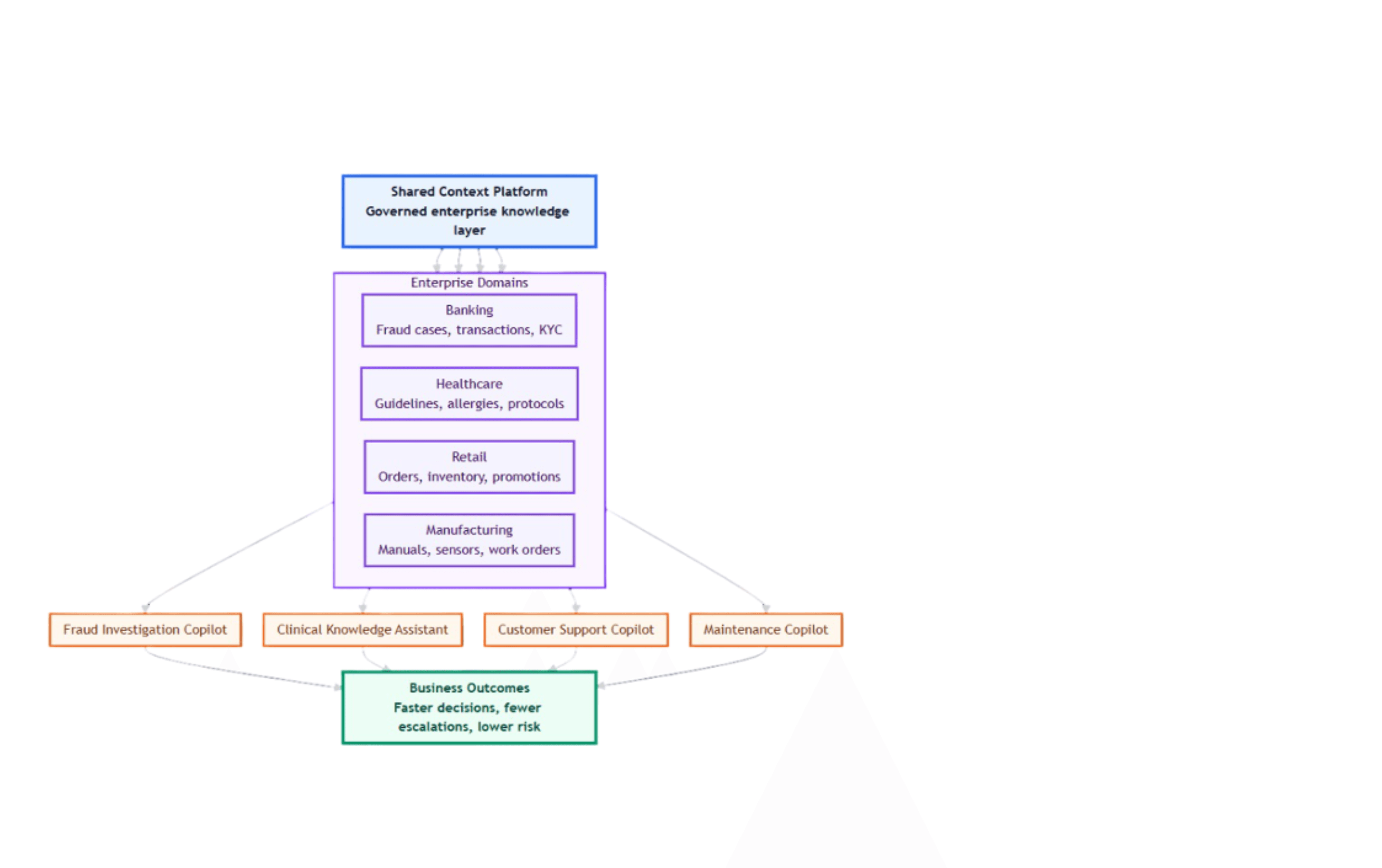
| Industry | Use Case | Context Engineering Value |
|---|---|---|
| Banking | Fraud investigation copilot | Pulls transaction history, customer profile, past cases, regulatory guidance, and watchlist signals so investigators spend less time gathering evidence. |
| Healthcare | Clinical knowledge assistant | Combines guidelines, patient allergies, facility formularies, and care protocols with strict citation requirements. |
| Retail | Intelligent customer support | Uses inventory, orders, promotions, customer history, product specs, and policy exceptions to answer accurately. |
| Manufacturing | Maintenance copilot | Connects manuals, sensor anomalies, maintenance history, spare parts, and technician notes to reduce downtime. |
| Pattern | When It Matters |
|---|---|
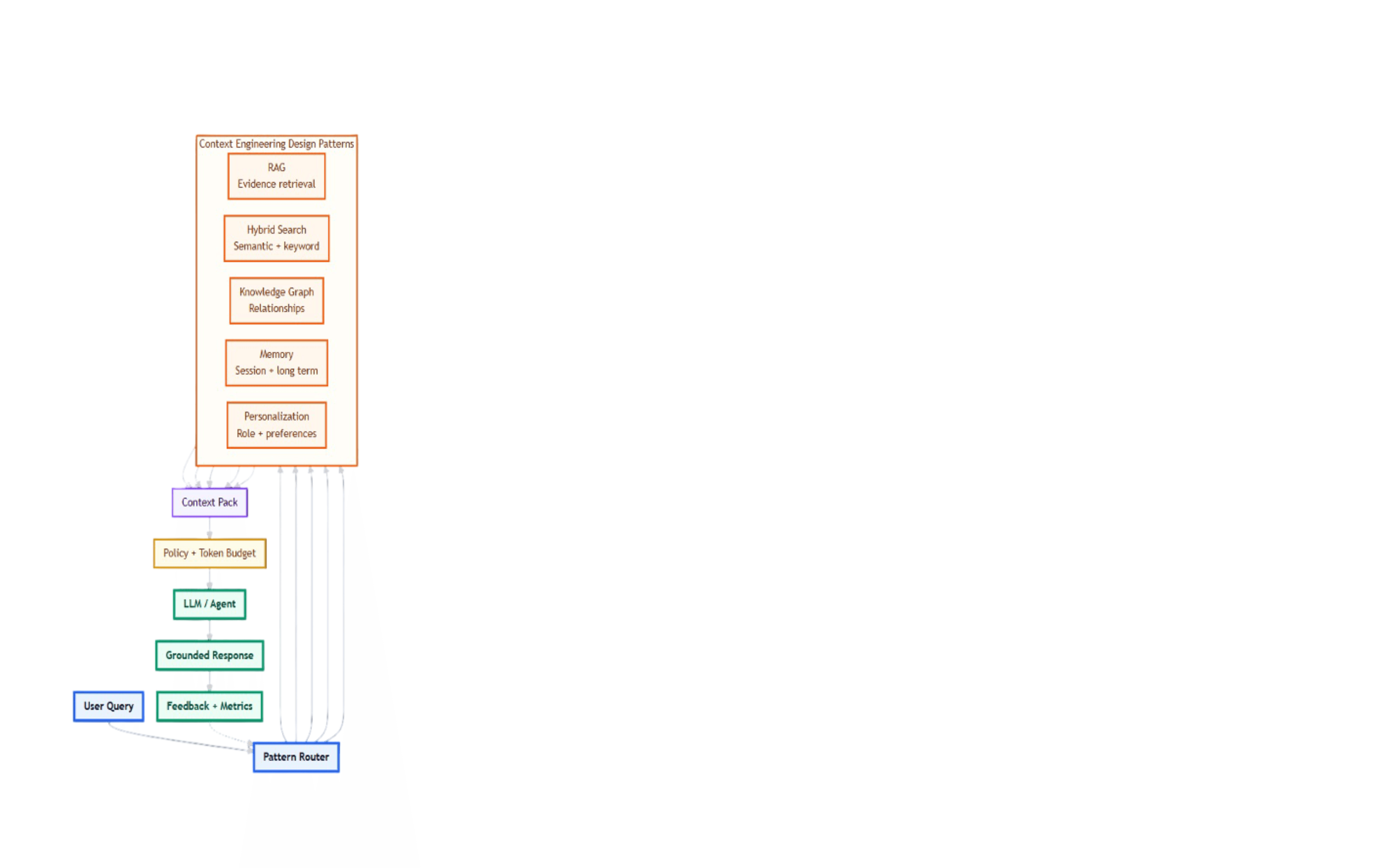
| RAG | Retrieves trusted enterprise evidence before generation. |
| Hybrid Search | Combines semantic search with exact keyword matching for product codes, acronyms, and policy names. |
| Long-Term Memory | Stores durable preferences, prior interactions, and workflow state across sessions. |
| Knowledge Graph Integration | Adds relationships between customers, products, assets, policies, and events. |
| Personalization Layer | Filters and ranks context based on role, permissions, geography, and history. |
| Metric | Question It Answers |
|---|---|
| Context Precision | How much retrieved context is relevant? |
| Context Recall | Did retrieval find important evidence? |
| Groundedness | Are claims supported by supplied context? |
| Hallucination Rate | How often does the AI produce unsupported claims? |
| Latency and Cost | Can the experience scale without becoming slow or expensive? |
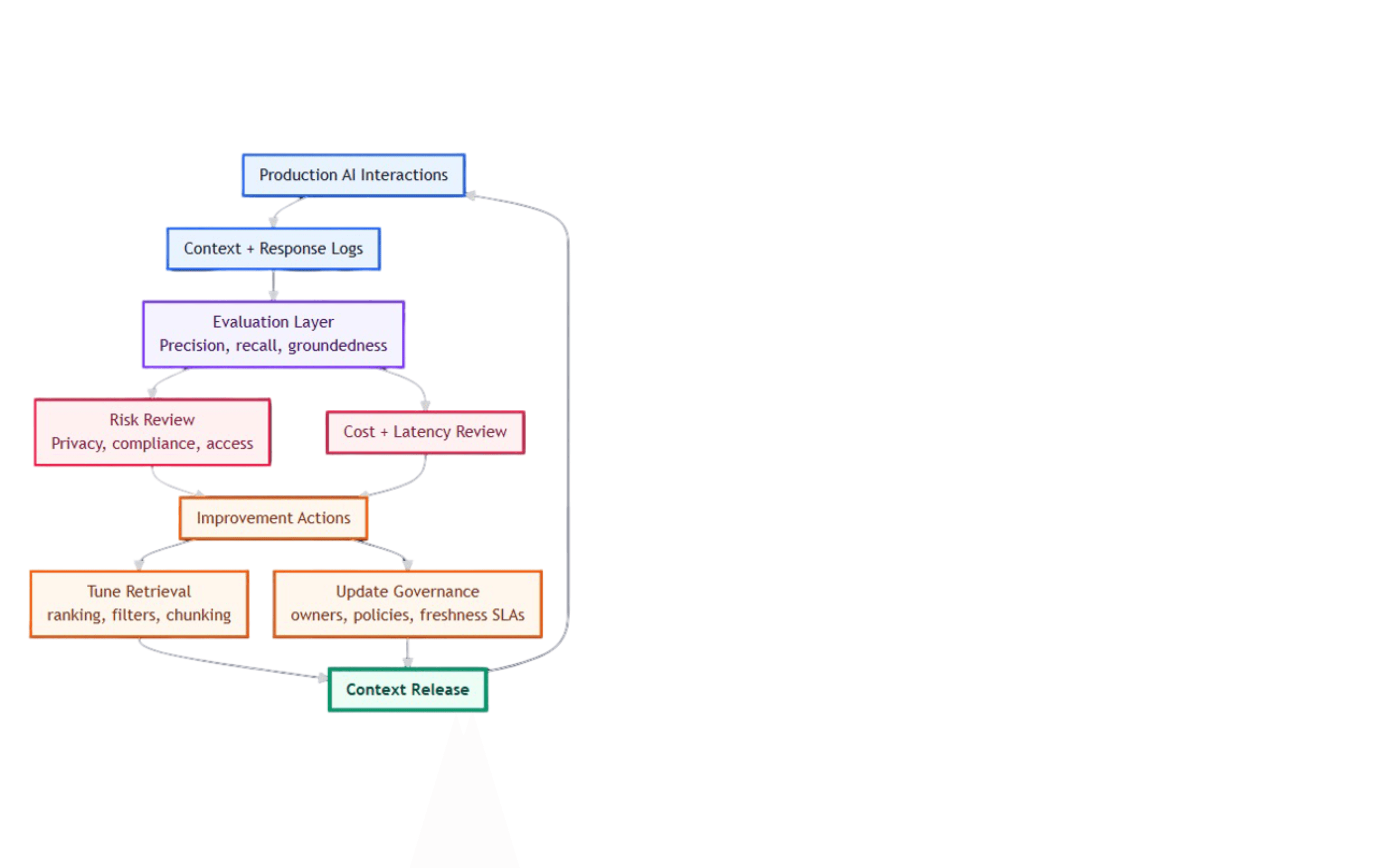
The hardest risks are not technical alone. Security, privacy, compliance, freshness, and access control must be designed into retrieval. Context should be filtered before it reaches the model, not cleaned up after generation. Every context source needs an owner, a refresh cadence, a data classification, and a measurable contribution to AI quality.
Mature teams also build evaluation sets around real business questions: claims disputes, policy exceptions, order inquiries, fraud alerts, maintenance failures, and clinical documentation scenarios. These test sets reveal whether the context layer is retrieving the right evidence, not merely whether the model can produce a polished answer.
Data Engineers are uniquely positioned to lead this shift because Context Engineering is not a prompt-writing exercise. It is an infrastructure discipline. It requires pipelines, quality checks, lineage, governance, access controls, orchestration, observability, and scalable serving layers. These are core Data Engineering strengths, now applied to AI grounding infrastructure.
| Traditional Data Engineering | Context Engineering |
|---|---|
| ETL pipelines | Knowledge pipelines |
| Data warehouses | Context and vector stores |
| Data quality | Context quality and groundedness |
| Pipeline orchestration | Context orchestration |
| BI enablement | AI grounding infrastructure |
Enterprise AI will not be won by model access alone. As foundation models become easier to consume, differentiation will come from the enterprise's ability to deliver trusted knowledge into AI workflows with speed, precision, and control. Context Engineering is the operating discipline that makes this possible.
Akshat Srivastava is a Data & AI Engineer in the Client Data Intelligence & Sales Tech team, specializing in Snowflake, DBT, Airflow, AWS, SQL, Python, ETL pipelines, RAG, MCP, Machine Learning, Deep Learning, and Agentic AI. Outside of work, he enjoys reading non-fiction books and exploring geopolitics.


Blogs you may like
There are no more blogs for this category